
Starting a business in Pakistan is an exciting journey, but understanding the legal requirements can be challenging for many entrepreneurs. One of the most common questions is whether a Trade License and Business Registration are the same. The simple answer is No. Although both are essential for many businesses, they serve different legal purposes. Understanding the difference can help you avoid penalties, ensure compliance, and build a Strong Foundation for your business.
What is Business Registration?
Business registration is the legal process of establishing your business as a recognized entity under Pakistani law. It gives your business a legal identity and allows you to operate formally. Depending on your business structure, registration may be completed through the Securities and Exchange Commission of Pakistan (SECP), the Registrar of Firms, or the Federal Board of Revenue (FBR).
Common business structures in Pakistan include:
- Sole Proprietorship
- Partnership (AOP)
- Private Limited Company
- Single Member Company (SMC)
- Limited Liability Partnership (LLP)
Once registered, your business can obtain an NTN, open a business bank account, sign contracts, participate in government tenders, and build credibility with customers, suppliers, and investors.
What is a Trade License?
A Trade License is an authorization issued by a local government authority, municipal corporation, metropolitan authority, or cantonment board that allows a business to conduct commercial activities at a specific location. Unlike business registration, a trade license does not establish ownership or create a legal entity. Instead, it ensures that your business complies with local regulations related to zoning, public safety, hygiene, and environmental standards.
Businesses such as restaurants, retail stores, warehouses, manufacturing units, pharmacies, hotels, clinics, and other commercial establishments often require a trade license before beginning operations.
The exact licensing requirements vary depending on the city, province, and nature of the business.
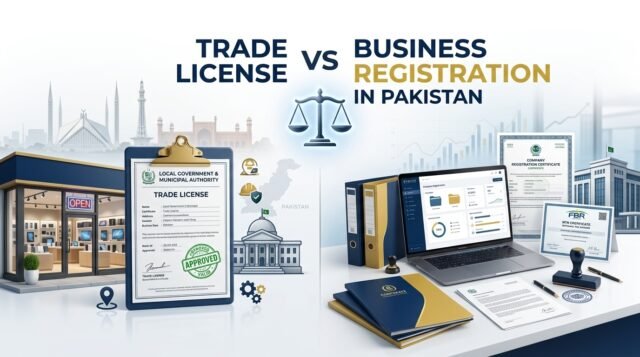
Trade License vs Business Registration
Although these terms are often used interchangeably, they are entirely different legal requirements.
| Feature | Trade License | Business Registration |
| Purpose | Permission to operate a business | Creates the legal identity of a business |
| Issued By | Local Government or Municipal Authority | SECP, FBR, or Registrar of Firms |
| Required For | Operating certain commercial activities | Establishing a legal business |
| Validity | Usually requires periodic renewal | Remains valid unless dissolved |
| Focus | Local compliance and safety | Legal recognition and taxation |
In simple terms, Business Registration establishes your business, while a Trade License allows your business to operate legally in a particular location.
Which Businesses Need Both?
Many businesses in Pakistan require both business registration and a trade license. These include:
- Restaurants and Cafés
- Retail Shops
- Supermarkets
- Travel Agencies
- Hotels and Guest Houses
- Manufacturing Units
- Warehouses
- Pharmacies
- Clinics and Hospitals
- Educational Institutes
- Beauty Salons
- Fitness Centers
For example, if you establish a travel company, you may need business registration, NTN registration, and additional licenses depending on the nature of your services and applicable regulations.
Benefits of Business Registration
Registering your business provides several long-term advantages:
- Establishes legal ownership
- Builds customer trust and business credibility
- Enables opening a corporate bank account
- Makes it easier to obtain financing
- Allows participation in tenders and contracts
- Supports tax compliance
- Facilitates future business expansion
A registered business also appears more professional, making it easier to attract investors and strategic partners.
Benefits of a Trade License
A valid trade license demonstrates that your business complies with local government regulations. It offers several important benefits, including:
- Legal permission to conduct commercial activities
- Compliance with municipal laws
- Reduced risk of penalties and business closure
- Increased customer confidence
- Better reputation with regulatory authorities
- Smooth inspections and renewals
For businesses operating physical premises, maintaining a valid trade license is an important part of legal compliance.
Documents Required
The required documents vary depending on the type of business and the relevant authority, but commonly include:
Business Registration
- CNIC of owner(s) or directors
- Business name
- Proof of address
- Partnership deed (if applicable)
- Incorporation documents (for companies)
- Contact details
Trade License
- CNIC copy
- Rent agreement or property ownership documents
- Utility bill
- Business address
- Passport-size photographs
- Any additional approvals required by the local authority
Common Mistakes to Avoid
Many entrepreneurs unknowingly create legal issues by:
- Assuming an NTN is the same as business registration.
- Believing SECP registration automatically includes a trade license.
- Starting operations before obtaining required approvals.
- Choosing the wrong business structure.
- Ignoring annual compliance and renewal requirements.
Seeking professional guidance early can help avoid these mistakes and save valuable time and money.
Why Choose G ALI & Co?
At G ALI & Co, we help entrepreneurs and businesses navigate Pakistan’s regulatory requirements with confidence. Our experienced consultants provide complete business registration and compliance solutions tailored to your needs.
Our services include:
- Company Registration (SECP)
- NTN Registration
- Sales Tax Registration
- Trade License Assistance
- Partnership Registration
- Travel & Tourism Company Registration
- DTS License Consultancy
- Accounting & Bookkeeping
- Payroll Management
- Tax Filing & Compliance
- Corporate Advisory Services
Whether you are launching a startup, opening a retail outlet, or expanding an existing business, our team ensures that your registrations are completed accurately and efficiently.
Conclusion
Understanding the difference between a Trade License and Business Registration is essential for every entrepreneur in Pakistan. Business registration gives your business legal recognition, while a trade license provides permission to operate from a specific location where required by local authorities. Depending on your industry and location, you may need one or both to remain fully compliant.
If you’re planning to start a business and are unsure about the legal requirements, G ALI & Co is here to help. Our expert consultants will guide you through every step of the registration process, ensuring your business starts on the right legal foundation.
Frequently Asked Questions
- Is a Trade License mandatory for every business?
No. It depends on your business activity, location, and local government regulations. - Is SECP registration the same as a Trade License?
No. SECP registration creates a legal company, while a trade license permits commercial operations at a specific location. - Can a sole proprietor register a business?
Yes. Sole proprietors can obtain an NTN and register with the relevant authorities where applicable. - Can I operate without a Trade License?
If your business activity legally requires one, operating without it may lead to penalties or enforcement action. - Why should I choose G ALI & Co?
We provide complete business registration, licensing, taxation, accounting, and compliance services, helping businesses across Pakistan operate legally and efficiently.